

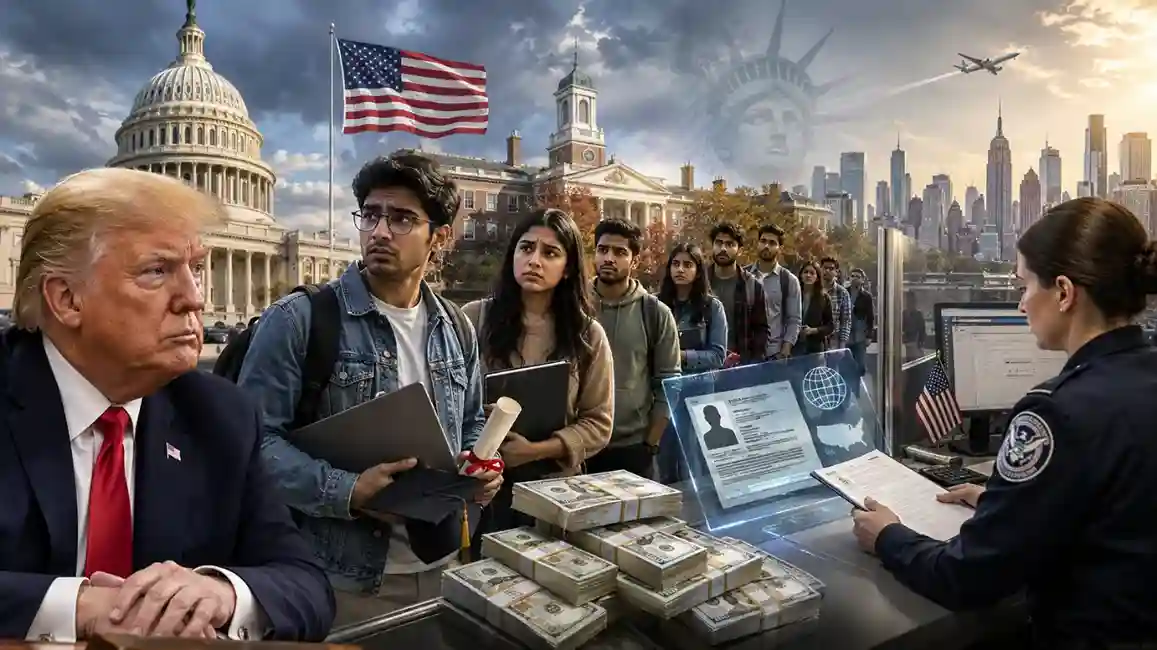
Trump 100k OPT Fee Proposal The Trump administration is considering a proposal to impose a mandatory $100,000 fee on international students seeking postgraduation work authorization in the United States through the Optional Practical Training (OPT) program. According to reports by The Wall Street Journal and Bloomberg, the internal proposal under discussion at the Department of Homeland Security (DHS) could significantly alter the financial viability of US higher education for foreign graduates, particularly Indian students who form the largest group of OPT participants.
Trump 100k OPT Fee Proposal – Key Provisions and Uncertainty Around Payment Burden
The OPT program currently allows F-1 student visa holders to remain in the US after graduation to gain practical work experience for up to one year, or up to three years for graduates in Science, Technology, Engineering, and Mathematics (STEM) fields. Under the proposal being discussed within DHS, a $100,000 charge would be attached to accessing the work permit. Administration officials have not finalized whether the fee would be born directly by the foreign graduates or required from the US companies hiring them.
Trump 100k OPT Fee Proposal – Significant Impact on Indian Graduates and US Higher Education
The proposed measure could disproportionately affect Indian students, who represent the largest international student body in the US. Data from the Open Doors Report indicates that nearly
98,000 Indian graduates participated in OPT during the 2024–25 academic year. Higher education analysts warn that imposing a six-figure barrier would make post-study work unaffordable for many students, potentially diverting global talent toward other popular study destinations like Canada, the UK, and Europe.
Trump 100k OPT Fee Proposal – Part of Broader US Student Visa Tightening Measures
The OPT fee discussion follows recent policy shifts by the DHS aimed at tightening international student oversight, including plans to replace open-ended “duration of status” rules with fixed-term visa stays. It also echoes the administration’s earlier attempt to introduce a $100,000 fee for certain H-1B work visas. While White House officials clarified that no final policy change has been formally announced, the proposal has drawn concerns from US universities and technology firms that rely on foreign graduates to fill skilled labor roles.
