


Yusuf Rana | Mumbai
Wire Centre
Rahul Gandhi Parliament Controversy: India’s Parliament is not simply a place where laws are passed. It is the country’s foremost democratic forum, where elected representatives raise the concerns of citizens, question those in power and debate issues that affect the nation. That is why every statement made inside Parliament carries significance — and every member is expected to balance the right to speak with the responsibility to respect the dignity of the House. The recent controversy surrounding a notice issued to Leader of Opposition Rahul Gandhi over his alleged use of expressions such as “idiot” and “andh bhakt” has once again brought a larger question into the national debate: how far can political speech go before it crosses the line of parliamentary decorum?
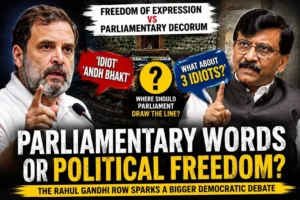

Rahul Gandhi Parliament Controversy – The “Idiot” Debate and Sanjay Raut’s Question
The controversy took a political turn after Shiv Sena (UBT) leader Sanjay Raut questioned the objection to the word “idiot,” referring to the popular Bollywood film 3 Idiots. Raut’s comparison was clearly political, but it raised an interesting point about language itself: can a word be considered inappropriate simply because of its dictionary meaning, or should the context, intention, target and manner in which it is used also be considered? This distinction is important because language does not operate in isolation — the same word can carry different implications depending on the situation in which it is spoken.
Rahul Gandhi Parliament Controversy – Freedom of Expression Versus Institutional Dignity
A strong opposition is an essential part of any functioning democracy. The opposition must be free to question government decisions, expose shortcomings and raise issues affecting ordinary citizens — if criticism itself becomes unacceptable, parliamentary democracy risks losing one of its most important checks on executive power. But freedom of expression also carries responsibility. Parliamentary debate can be aggressive, passionate and politically sharp without becoming personally insulting; the objective should be to challenge policies, decisions and arguments, not unnecessarily attack individuals. The real challenge, therefore, is to protect freedom of speech without allowing parliamentary debate to descend into personal confrontation.
The controversy also raises a crucial issue of consistency. Parliamentary rules should apply equally to members of the ruling party and opposition, regardless of political affiliation — if identical or similar expressions are treated differently depending on who uses them, questions about selective enforcement are bound to arise. Rules can protect the dignity of Parliament only when members and the public believe those rules are being applied fairly, transparently and without political bias.
Rahul Gandhi Parliament Controversy – Is Parliament Losing Focus on Bigger Issues?
There is also a larger concern behind this controversy. India continues to face major challenges involving employment, inflation, education, healthcare, economic growth and social welfare — issues that directly affect millions of citizens. When political attention becomes dominated by individual words, slogans and verbal clashes, there is a danger that these larger policy questions get pushed into the background. Parliament should certainly maintain discipline and decorum, but the ultimate purpose of parliamentary debate must remain the same: finding solutions to the problems of the people.
The responsibility does not rest with one side alone. The opposition has a democratic right — and responsibility — to question the government, and its criticism should ideally be factual, evidence-based and constructive. At the same time, the government must understand that criticism is not an attack on democracy; dissent is democracy, accountability is democracy, and questioning those in power is democracy. A government confident in its policies should be able to face strong questions, just as an opposition that wants to be taken seriously must ensure its strongest arguments are not weakened by unnecessary personal attacks.
Rahul Gandhi Parliament Controversy – The Bigger Constitutional Question.
The Rahul Gandhi parliamentary language controversy ultimately points to a much larger issue: how should a democracy balance freedom of expression with institutional dignity? There should be no attempt to create a Parliament where members are afraid to speak freely, but at the same time, Parliament cannot become a space where personal insults replace substantive political debate. The answer requires context, consistency, restraint and institutional maturity — parliamentary rules should protect the dignity of the House, but they should not become a convenient mechanism for avoiding uncomfortable criticism.
A mature democracy is not one without disagreement; it is one that allows strong disagreement while ensuring democratic institutions continue to function with dignity. The strength of Parliament should not be measured by how many words it removes from its records, but by the quality of the debates it conducts, the accountability it demands and the solutions it produces. India does not need less political debate — India needs better political debate. The Rahul Gandhi “idiot” and “andh bhakt” controversy may eventually pass, but the larger question will remain: can Parliament protect its dignity without weakening the freedom to question those in power? The answer should be neither unrestricted political rhetoric nor excessive restrictions on dissent, but a democratic middle path — freedom with responsibility, criticism with facts, disagreement with dignity, and parliamentary rules applied equally to everyone. That is the balance a mature democracy must strive to achieve.