


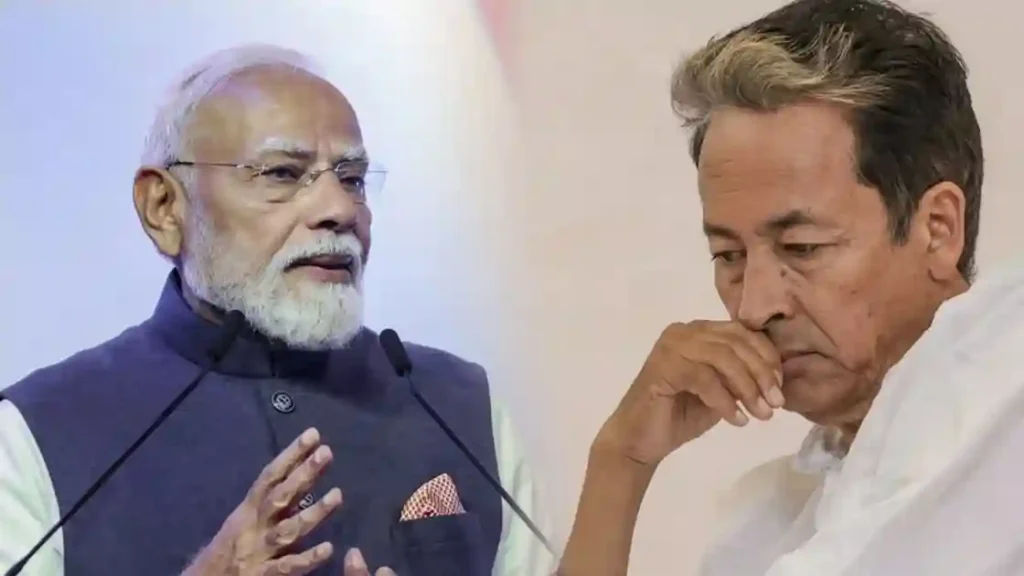
The transition of Magsaysay awardee and educator Sonam Wangchuk from a highly respected institutional ally of the Union government to a protesting dissident at New Delhi’s Jantar Mantar represents a dramatic turning point in contemporary Indian public discourse. Just a few years ago, Wangchuk maintained a remarkably warm and constructive equation with Prime Minister Narendra Modi’s administration, publicly praising federal initiatives and collaborating on highprofile solar engineering projects. However, a series of complex geopolitical shifts, unfulfilled constitutional promises in Ladakh, and escalating civil agitations over domestic governance issues have completely fractured this relationship. Today, as Wangchuk pushes through an arduous indefinite hunger strike alongside student groups demanding the resignation of the Union Education Minister, the complete collapse of his channels of dialogue with the central leadership stands as a stark indicator of the deep divisions currently defining the sociopolitical landscape.
Jantar Mantar Protest – The Era of Mutual Admiration and the 2019 Autonomy Celebration
The relationship between Sonam Wangchuk and the ruling dispensation was originally rooted in mutual respect, reaching its peak during the structural reorganization of Jammu and Kashmir in August 2019. When the Centre modified Article 370 and officially designated Ladakh as a distinct Union Territory, Wangchuk was among the most prominent regional voices to publicly celebrate the move, extending formal gratitude directly to Prime Minister Modi for fulfilling a decades-old regional aspiration. During this cooperative phase, Wangchuk’s educational venture, the Himalayan Institute of Alternatives, Ladakh (HIAL), even secured prestigious recognition from the Union Ministry of New and Renewable Energy for its sustainable architectural innovations, illustrating an era where the renowned engineer was viewed by New Delhi as a vital developmental partner rather than a political adversary.
Jantar Mantar Protest – The Constitutional Deadlock and the Application of Severe Legal Measures
The absolute breakdown of this partnership began when local Ladakhi leadership realized that the transition to a Union Territory stripped the region of critical land and employment safeguards previously maintained under older state laws. A unified political front emerged, demanding Sixth Schedule protections and full statehood, which led to a series of escalating street demonstrations that eventually turned confrontational. The relationship degraded entirely when local administrations revoked HIAL’s long-term land leases, an action Wangchuk openly categorized as an institutional witch-hunt aimed at crushing political dissent. The confrontation peaked when federal security agencies, citing concerns over unstable rhetoric, briefly detained the activist under the stringent National Security Act (NSA), drawing a sharp line between the activist’s previous state honors and his new status as a major threat to public order.
Jantar Mantar Protest – The Jantar Mantar Aggregation and the NEET-UG Accountability Standoff
The current standoff at Jantar Mantar expands this regional conflict onto the national stage, as Wangchuk has formally aligned himself with the Cockroach Janta Party (CJP) to champion the grievances of millions of domestic students impacted by recent examination discrepancies. Now deep into a physically draining indefinite fast to demand accountability over the NEET-UG paper leak row, Wangchuk finds himself entirely isolated from the federal government, which has refused to initiate official dialogue and has aggressively labeled the student-led assembly as politically compromised. With opposition parties using the fast to draw unfavorable comparisons to historical civil rights demonstrations, the complete silence from the Prime Minister’s Office highlights a total systemic collapse of communication with an iconic figure who once walked the corridors of power as a celebrated innovator.