


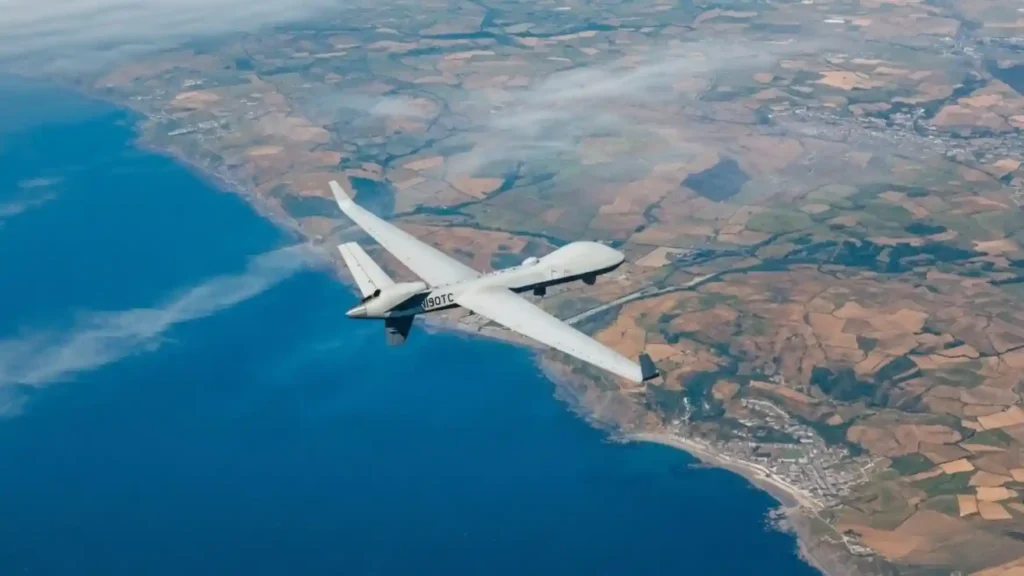
India MQ9B Predator Drones The Indian armed forces are executing a major upgrade to their national surveillance and reconnaissance capabilities through a formalized strategic contract to procure 31 MQ9B Predator drones from the United States. This highprofile, governmenttogovernment defense deal aims to deploy cuttingedge unmanned technology to monitor India’s vast maritime interests and long, contested land frontiers. Equipped with sophisticated satellite connectivity and advanced sensor suites, these HighAltitude LongEndurance (HALE) aircraft can remain operational far longer than traditional piloted aircraft. By integrating these stateoftheart platforms, New Delhi is actively bridging its persistent intelligence gaps across critical strategic corridors.
India MQ-9B Predator Drones – Strategic Inter-Service Allocation and Unmatched Flight Endurance
The newly acquired fleet of 31 remotely piloted drones will be carefully partitioned across the three wings of the Indian military to maximize operational efficiency. The Indian Navy is slated to receive the largest share with 15 specialized SeaGuardian variants, which will be tasked with patrolling the expansive Indian Ocean Region, tracking foreign naval movements, and securing key global shipping lanes. Meanwhile, the Indian Army and the Indian Air Force will each be allotted 8 SkyGuardian variants to reinforce security along the high-altitude Himalayan borders facing China and Pakistan. Boasting an extraordinary flight endurance exceeding 35 to 40 hours and the capacity to operate at altitudes up to 50,000 feet, these hunter-killer drones provide an unprecedented, all-weather aerial picture without risking the lives of human pilots.
India MQ-9B Predator Drones – Domestic Assembly, Technology Transfers, and the MRO Maintenance Facility
A foundational element of this bilateral agreement is its heavy emphasis on domestic industrial participation and local capacity building under India’s manufacturing initiatives. Out of the 31 total aircraft, 10 units will be delivered in a ready-to-fly condition, while the remaining 21 drones will be fully assembled domestically within India utilizing locally sourced components. Furthermore, a separate capital investment exceeding ₹4,000 crore has been designated to establish a comprehensive, depot-level Maintenance, Repair, and Overhaul (MRO) facility inside the country. This state-of-the-art hub will ensure localized technical support for up to 150,000 flying hours, while American defense manufacturer General Atomics will simultaneously collaborate with India’s Defence Research and Development Organisation (DRDO) to advance indigenous drone programs.
India MQ-9B Predator Drones – Weapons Payload Configurations and Regional Tactical Vulnerabilities
Beyond pure reconnaissance, the MQ-9B platforms possess immense combat capabilities, featuring a robust payload capacity that can be integrated with precision-guided munitions. The drones can carry up to four AGM-114 Hellfire air-to-ground missiles alongside sophisticated laser-guided smart bombs, allowing operators to neutralize hostile assets with pinpoint accuracy. However, global defense analysts note that despite their immense strategic value, large and slow-moving drones face real operational vulnerabilities when deployed in highly contested airspace managed by advanced air defense networks. To counter these challenges, Indian military commanders plan to seamlessly network the Predator fleet with existing radar systems, military satellites, and naval warships, maximizing their tactical utility in complex modern warfare environments.