


Santosh Nanavare | Mumbai
Wire Centre
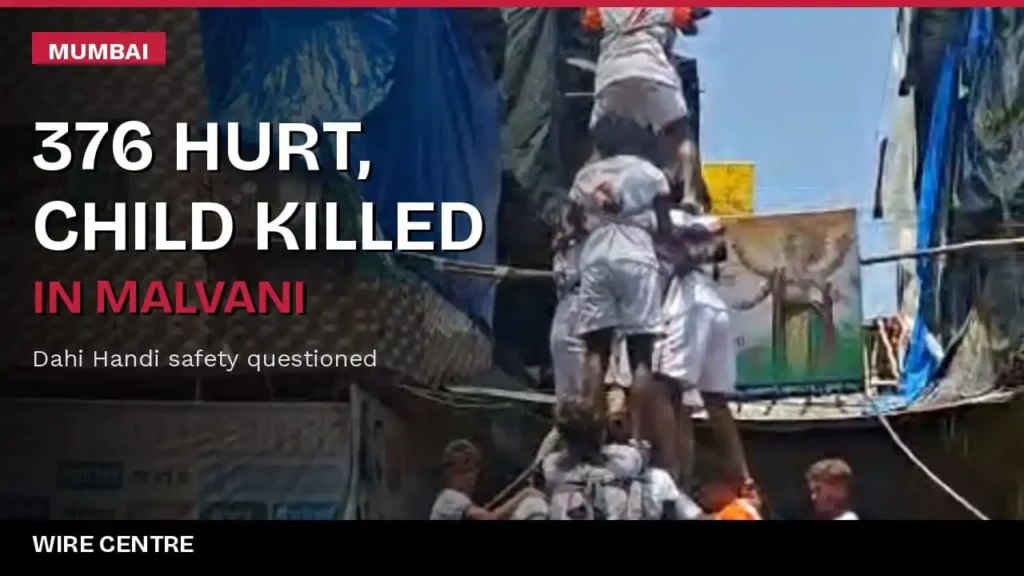
Dahi Handi 2026 Injuries: Mumbai once again rang out with cries of “Govinda Aala Re Aala” as Krishna Janmashtami celebrations swept the city — but behind the dhol beats, DJ music and prize money lay a familiar, sobering story: hundreds of injured Govindas and, this year, a heartbreaking loss of a young life. The festival, which draws thousands of participants across Mumbai’s neighbourhoods every year in pursuit of ever-taller human pyramids and larger prize purses, has again left behind a trail of hospital admissions and, tragically, two deaths — a pattern that has now repeated for several years running despite growing attention to safety measures and government-backed insurance cover.

Dahi Handi 2026 Injuries
Dahi Handi 2026 Injuries – The Numbers: 376 Injured Across the City
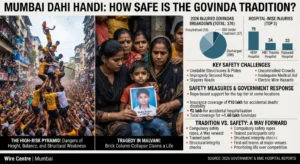
According to hospital-wise data, 376 Govindas were injured during this year’s celebrations, with 53 admitted to hospitals, 37 still under treatment and 286 discharged after receiving care. The injuries were spread across the city’s three main hospital zones — Central Mumbai bore the brunt with 183 cases, Western Suburbs reported 126, and Eastern Suburbs recorded the rest. Hospital-wise, Central hospitals logged 29 admissions, 23 under treatment and 131 discharges, while Western Suburban hospitals reported nine admitted, 14 under treatment and 103 discharged. Among individual hospitals, KEM once again topped the list with the highest single-hospital caseload, followed by HBT Trauma Hospital, Rajawadi, V. Desai and Nair Hospital — a distribution that has remained broadly consistent with previous years, reflecting how central Mumbai’s dense concentration of Dahi Handi events continues to generate the bulk of the city’s injury load each Janmashtami.
Dahi Handi 2026 Injuries – Malvani’s Unbearable Loss
Amid the citywide festivities, one incident stopped the celebrations cold. Seven-year-old Rudra Kadam died after a brick column collapsed on him during a local Dahi Handi celebration at Ekta Welfare Society in Chikuwadi, Malvani, Malad West, suffering a severe head injury. A group of children had organised the celebration on their own, with one end of the rope holding the handi tied to a tree and the other attached to a brick column supporting a ground-floor structure; as the children attempted to break the handi, the column collapsed and buried Rudra under the debris. He was rushed to Malvani General Hospital, where doctors declared him brought dead; he is survived by his father, a labourer, and his mother, a domestic worker. Rudra’s death was not the only fatality linked to this year’s festivities. In Pune, a 45-year-old woman named Salma Salauddin Pathan died after a temporary iron structure supporting loudspeakers for a Dahi Handi event collapsed on her while workers were dismantling it. Together, the two deaths cast a shadow over an otherwise exuberant citywide celebration, once again raising uncomfortable questions about how unsupervised, self-organised events at the neighbourhood level are able to proceed without any structural safety checks at all.
Dahi Handi 2026 Injuries – A Climbing Toll, and What’s Being Done About It
This year’s injury count is not an aberration — it’s part of a troubling pattern. More than 200 Govindas were injured in 2022, 245 were injured in 2024, and 318 were injured in 2025. The 2025 festival also claimed two lives even as more than 300 people were injured across Mumbai and Thane. This year’s 376 marks the highest tally in recent years — underlining that as human pyramids grow more ambitious, the risks are growing right along with them. Anticipating this, the Maharashtra government had expanded its safety cover ahead of this year’s festival, extending insurance protection to 1.60 lakh Govindas, with ₹10 lakh compensation for accidental death or permanent total disability, ₹5 lakh for the loss of a hand, leg or eye, and up to ₹1 lakh for hospitalisation expenses — funded through the State Sports Development Fund with a premium of ₹75 or less per participant. Dahi Handi’s formal recognition as an “adventure sport” also means government and civic hospitals are required to treat injured Govindas free of cost. Yet, as this year’s tragedy in Malvani shows, insurance payouts and free treatment can soften the financial blow — they cannot undo the loss of a seven-year-old boy, or bring back a mother’s son. Safety advocates have urged organisers to make safety belts mandatory for Govindas climbing the upper tiers of human pyramids and to ensure medical assistance is readily available at every venue, while stressing that the structural integrity of the trees, columns, walls and buildings used to anchor the handi rope — often makeshift, unverified and never load-tested — deserves just as much scrutiny as the human tower itself.