


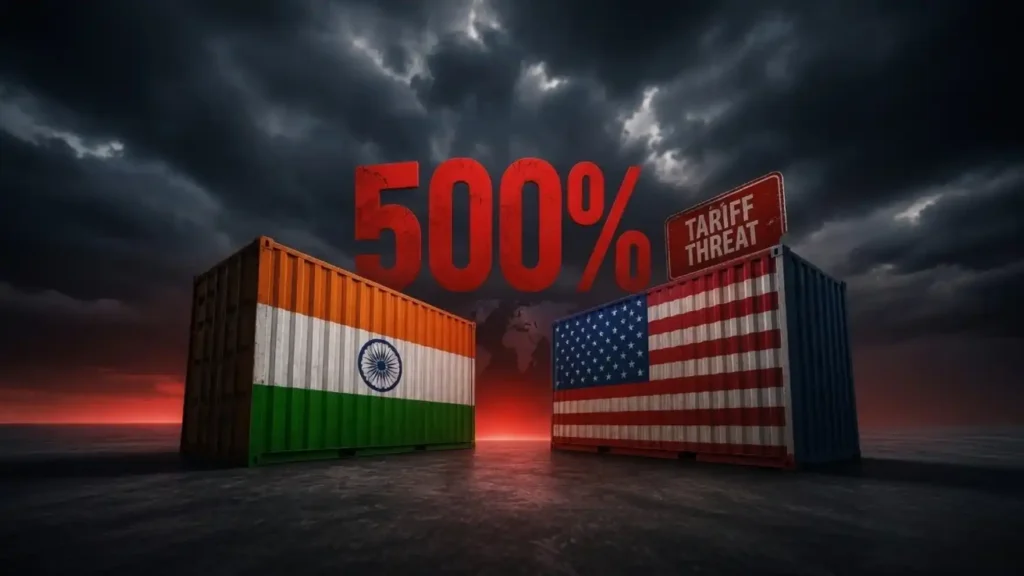
US India Tariffs The United States is escalating economic pressure on global buyers of Russian energy by advancing the “Sanctioning Russia Act of 2025,” a bipartisan bill that has received the official backing of President Donald Trump. Spearheaded by Senator Lindsey Graham, the proposed legislation grants the US executive broad powers to impose punitive tariffs of up to 500% on countries that continue to purchase Russian crude oil, petroleum products, natural gas, or uranium. This severe trade measure functions as a secondary sanction aimed directly at choking off the revenue streams funding Moscow’s military actions. For India, which has heavily relied on discounted Russian crude to stabilize its domestic energy costs, the threat introduces an unprecedented crisis for its export economy.
US India Tariffs – Escalating Trade Pressures and the Existing Tariff Structure
India is already navigating a restrictive trade environment with Washington, following the Trump administration’s deployment of the International Emergency Economic Powers Act (IEEPA) in mid-2025. This move previously levied a 25% base tariff on major Indian goods, which was later combined with an additional 25% penalty specifically tied to Russian oil purchases, resulting in a cumulative 50% tariff. If the newly proposed bill successfully clears Congress, it will authorize the US President to dramatically elevate those duties up to 500%. Such an extreme ad valorem tax would effectively multiply the cost of Indian merchandise by five times, pricing crucial sectors out of the United States—which represents roughly 17% of India’s total global export market.
US India Tariffs – Devastating Economic Implications for India’s Core Sectors
The materialization of a 500% tariff threat would trigger severe disruptions across India’s domestic manufacturing and service sectors, endangering over $120 billion in annual trade value. High-stakes export engines like gems and jewelry, textiles, engineering goods, and pharmaceuticals would face a near-total loss of market share in the US, directly threatening millions of industrial jobs in hubs like Surat and Tirupur. Furthermore, India’s robust IT services sector could face steep operational cutbacks and subsequent workforce reductions. Economists warn that the secondary shockwaves could result in an annual foreign exchange loss exceeding $50 billion, placing immense strain on the Indian rupee and the country’s fiscal balance.
US India Tariffs – Strategic Autonomy Versus Energy Security Dilemmas
While India has historically prioritized its strategic autonomy and domestic energy security by sourcing roughly 35% to 40% of its crude oil from Russia at heavily discounted rates, Washington’s aggressive posture is forcing a diplomatic recalibration. Recent market data shows that New Delhi has already begun “gearing down” its intake of Russian crude, with imports dropping noticeably from their mid-2025 peaks as Indian refiners look toward alternative suppliers in West Asia, Africa, and the Americas. However, completely pivoting away from Russian oil poses a distinct financial risk, potentially inflating India’s national import bill by $9 billion to $11 billion annually. Diplomatic channels between New Delhi and Washington remain highly active as Indian negotiators leverage these import reductions to seek targeted exemptions before the bill moves to a decisive vote.