


By Yusuf Rana | Wire Centre
Strait of Hormuz Blockade: The Strait of Hormuz, the narrow waterway between Iran and Oman that carries roughly a fifth of the world’s crude oil, has been in and out of shutdown since the US-Israel war on Iran erupted in February. What began as a wartime closure has hardened into a prolonged standoff, and the consequences are now rippling far beyond the Gulf — into fuel pumps, shipping schedules and inflation numbers across Asia, including in India. For a waterway that handles roughly a quarter of the world’s seaborne oil trade and a fifth of its LNG shipments, even intermittent closures send shockwaves through global markets, and the longer this standoff drags on without a resolution, the more entrenched those effects are becoming across economies that had little direct stake in the underlying conflict. Governments, shipping companies, and energy markets alike are now bracing for the possibility that this disruption may not be a short-term crisis but a prolonged new normal for one of the world’s most critical trade arteries.

Strait of Hormuz Blockade – A Waterway Under Siege.
Iran shut the strait to foreign shipping in late February after the assassination of its Supreme Leader, with the Islamic Revolutionary Guard Corps warning that no vessel would be allowed to pass. Washington responded with an aerial campaign to reopen the route and later imposed its own naval blockade on Iranian ports. A ceasefire and a US-Iran memorandum in mid-June briefly restored toll-free passage, but the truce collapsed in early July after fresh attacks on commercial vessels — and the strait has been effectively shut to routine traffic ever since. The toll is mounting: merchant ships have been damaged, boarded and in some cases sunk; seafarers have been killed or gone missing; and thousands of mariners remain stranded aboard vessels waiting out the crisis. As of this week, traffic through the strait has slowed to a trickle, with maritime intelligence firms tracking crossings falling into the single digits on some days, even as Iran and Oman edge toward a possible framework for safe passage.
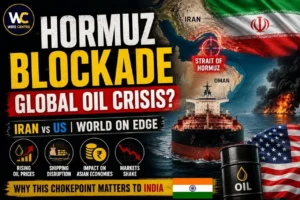

Strait of Hormuz Blockade – The Standoff Deepens.
Diplomacy has repeatedly stalled. Iran’s Supreme National Security Council issued a list of conditions this month for reopening the strait — including a full end to the war, withdrawal of US forces, compensation for war damage and the release of frozen Iranian assets — while President Trump has countered with his own demands, including compensation from Tehran. Iran’s parliament has separately moved to formally bar US- and Israel-linked vessels from the strait altogether and impose a toll on others, a plan Washington has rejected. With both sides digging in, a return to normal, unfettered shipping looks further away than it did even a month ago.
Strait of Hormuz Blockade – Oil Prices, Shipping Chaos and India’s Stake.
Every disruption in the strait tightens global energy supply, and tighter supply means higher prices at the pump, in electricity bills and in the cost of running factories, feeding directly into inflation for consumers far from the Gulf. Vessels are being rerouted around the danger zone, marine insurance premiums have surged, and cargo delays are cascading through global supply chains, with industries reliant on just-in-time imports absorbing production delays and mounting losses. With the Red Sea route also disrupted by Houthi attacks, shippers are increasingly funnelled toward the much longer Cape of Good Hope route, adding weeks to voyages that once took days. Asian economies — India, China, Japan and South Korea foremost among them — remain acutely exposed to the disruption. For India, a sustained closure threatens higher import bills, pressure on the rupee, and knock-on effects for growth at a time when the economy can ill afford new shocks.
Beyond the economics, the crisis has sharpened geopolitical tension across the Gulf, with repeated strikes, naval confrontations and the threat of further escalation unsettling regional governments and global investors alike. Experts and diplomats broadly agree that only a negotiated settlement — not further military pressure — can durably reopen the strait. Talks between Iran and Oman on a safe-passage framework, and the broader push for a ceasefire, remain the most active tracks toward de-escalation. Until one of them holds, the world’s most important energy chokepoint will remain a source of uncertainty for economies far beyond the Middle East.