


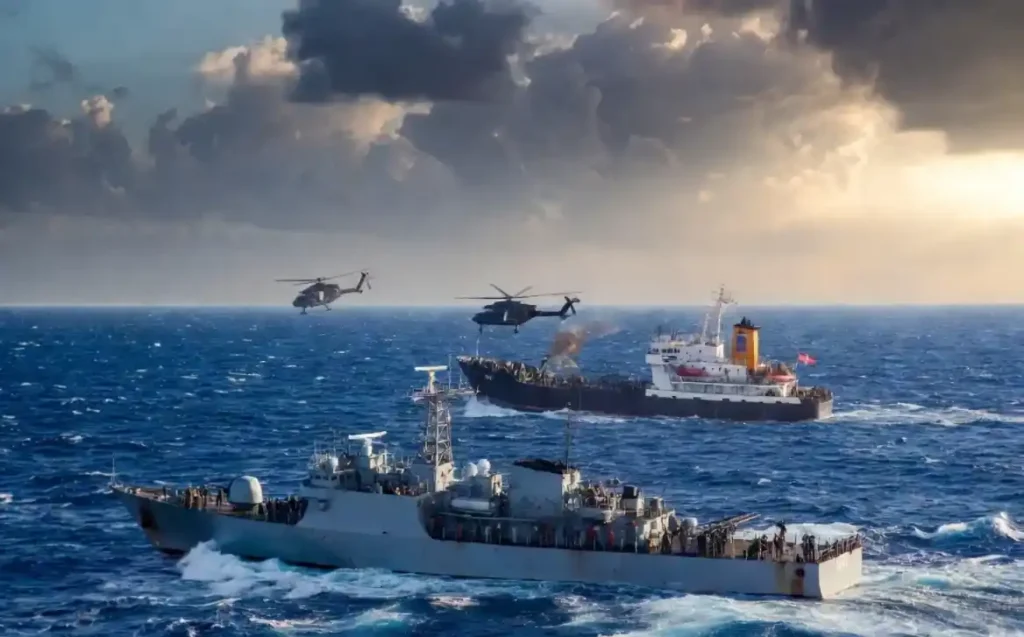
Indian Navy A critical highseas crisis was averted in the strategic waters of the Gulf of Aden when the Indian Navy’s stealth frigate, INS Trikand, and elite Marine Commandos (MARCOS) intercepted an active piracy attempt on the merchant vessel MV Golden Arsenal. The St. Vincent and the Grenadinesflagged bulk carrier, transporting vital industrial consignments destined for Indian ports, came under heavy assault from armed pirates approximately 300 nautical miles eastnortheast of Djibouti. By executing standard antipiracy maneuvers, the 21member multinational crew safely barricaded themselves inside the ship’s armored citadel, escaping harm even as the vessel’s bridge superstructure sustained physical damage during the initial pirate raid. This successful interception highlights India’s expanding role as a primary net security provider across critical international trade chokepoints.
Indian Navy – Tactical Intervention By INS Trikand Following Mid-Ocean Distress Alert
In a decisive demonstration of operational readiness and maritime dominance, the Indian Navy successfully neutralized a coordinated piracy threat in the volatile waters of the Gulf of Aden late Wednesday night. The high-stakes emergency began when the frontline Indian warship, INS Trikand, which was actively patrolling the region, intercepted an urgent distress transmission from a commercial cargo ship identified as the MV Golden Arsenal. The merchant vessel was transporting a highly sensitive and critical consignment directly destined for Indian ports, making its safety a priority for regional security forces. Recognizing the immediate danger as suspected armed pirates attempted a aggressive boarding maneuver, the commanding officers of INS Trikand immediately altered course. Advancing at maximum operational velocity, the Indian warship closed the distance to the vulnerable vessel. The sudden approach of a heavily armed naval platform projected a powerful deterrent effect, forcing the criminal elements to abandon their boarding attempt and retreat into the open ocean before they could compromise the ship’s control systems or capture the mariners.
Indian Navy – Elite MARCOS Special Forces Execute Systematic Boarding And Sanitisation
The operational success was heavily reinforced by the rapid deployment of the Indian Navy’s premier special forces unit, the Marine Commandos, popularly known as MARCOS. Prior to the arrival of naval assets, the seafaring crew of the MV Golden Arsenal—which notably included an Indian national—had perfectly executed established international anti-piracy emergency protocols. Upon detecting the approaching pirate skiffs, the crew members immediately gathered and locked themselves inside the ship’s heavily fortified citadel. This specialized safe room is designed to withstand forced entries and is equipped with independent communications, effectively preventing attackers from seizing control of the vessel’s propulsion or navigation decks. Once INS Trikand established a protective perimeter around the merchant carrier, the highly trained MARCOS operators conducted a tactical boarding sequence. The commandos carried out an exhaustive, room-by-room sanitisation sweep across every deck, cargo hold, and engine space to guarantee that no hostile entities remained hidden on board. Following the thorough security clearance, the ship was declared entirely secure, with defense sources confirming zero injuries to the crew and no physical damage to the critical cargo.
Indian Navy – Strategic Significance Of Ongoing Naval Deployments In Critical Trade Corridors
This successful defense operation highlights the vital importance of the Indian Navy’s persistent, long-term deployment strategy throughout the highly congested sea lanes of communication near the Horn of Africa. The Gulf of Aden represents one of the world’s most critical maritime choke points, serving as a primary transit route for global trade traveling between Asia, the Middle East, and Europe. However, its geographical proximity to unstable coastal regions leaves commercial shipping highly vulnerable to asymmetric threats, including piracy networks and regional conflict spillover. Over the past twenty-four months, India has significantly increased its presence by keeping multiple warships, guided-missile destroyers, and long-range maritime surveillance aircraft on continuous rotation across the Arabian Sea and adjacent oceanic expanses. This proactive posture is engineered to safeguard international maritime traffic, protect Indian seafarers, and guarantee the unhindered flow of essential commerce. By consistently responding to high-seas emergencies with speed and overwhelming force, the Indian Navy reinforces its reputation as a preferred security provider and a reliable guardian of international maritime law across the Indian Ocean Region.
👉 Also Read:
Mumbai Monsoon Alert Heavy to Very Heavy Rainfall Expected in Mumbai and MMR Tomorrow