


Vinod Gholap | Mumbai
Wire Centre
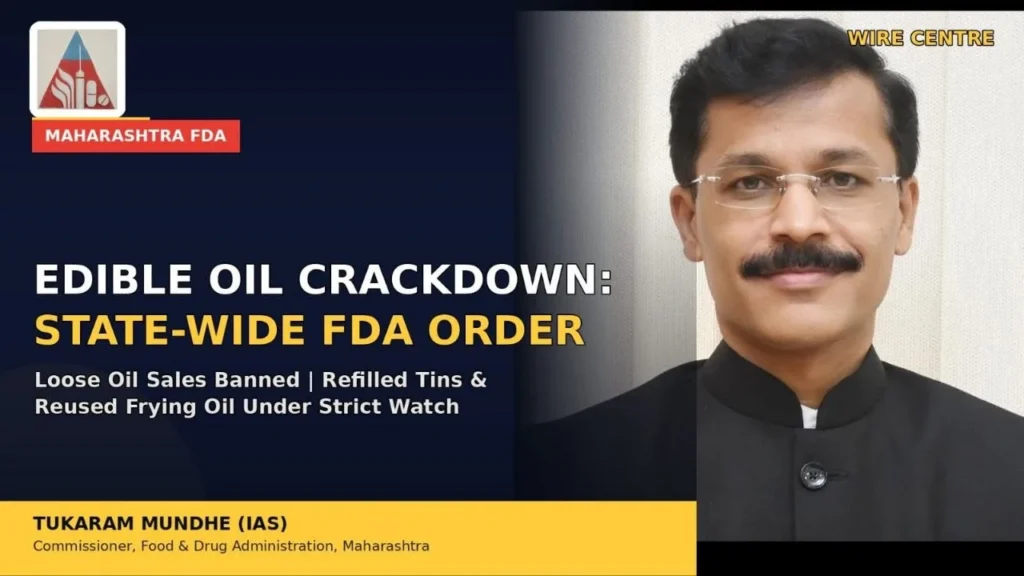
Maharashtra FDA Edible Oil Order: If you buy loose, unpackaged cooking oil from your local shop, this is a story you need to read. The Food and Drug Administration (FDA), Maharashtra, has issued a sweeping, state-wide compliance order covering the entire edible oil and fat industry — from oil-processing units all the way down to retail and online sellers. Under the Food Safety and Standards Act, 2006, Food Safety Commissioner and FDA Commissioner Shri Tukaram Mundhe (IAS) has issued a fourteen-point enforcement order, effective immediately, after inspections uncovered widespread and persistent non-compliance across the oil supply chain, including businesses operating without valid licences, cheap undeclared oil mixed into branded oil, substandard oil exceeding acid value and trans-fat limits, unauthorised blending of mustard oil, relabelling that hides the oil’s true source and date, repacking near-expiry oil, and use of packaging unfit for food contact.
Maharashtra FDA Edible Oil Order – Who the Order Applies To.
The order covers oil expeller units, solvent extraction units, refiners, manufacturers of vanaspati, interesterified fat, bakery shortening, margarine and table spreads, blenders of multi-source vegetable oil, repackers and relabellers, importers, wholesalers, distributors, super-stockists and transporters — as well as grocery stores, supermarkets, department stores and e-commerce sellers. It applies to every type of edible oil, including groundnut, mustard, soybean, sunflower, safflower, sesame, corn, multi-source vegetable oil, and vanaspati, regardless of business size or turnover. Maharashtra currently has 497 edible oil manufacturers — 212 holding central licences and 285 holding state licences. During 2025-26, the FDA tested 1,247 edible oil samples: 1,142 were found compliant, while 77 were substandard, 13 unsafe, and 15 misbranded.
Maharashtra FDA Edible Oil Order – Key Directives: Sealed Packaging, No Reused Tins.
Every business must hold a valid FSSAI licence displayed at the premises, and oil manufacturers must maintain their own in-house testing laboratory rather than relying solely on external labs. Edible oil can now be sold only in sealed, tamper-evident packaging — the sale of loose, unpackaged oil is banned outright, with manufacturers or distributors dispatching loose oil held as the primary violator. Multi-source edible vegetable oil can only be sold in AGMARK-certified, sealed packs not exceeding 15 kg, with clear labelling of component oils, while mustard oil must be sold only in its 100% pure form. The presence of argemone oil, mineral oil, castor oil and tri-ortho-cresyl phosphate is strictly prohibited, industrial trans-fatty acids cannot exceed 2%, and once-used tin containers cannot be reused under any circumstance.
Maharashtra FDA Edible Oil Order – Three Malpractices Under the Scanner.
The FDA has flagged three practices as posing the most direct risk to public health. Loose, unpackaged oil makes tracing contamination nearly impossible and raises adulteration risk, with argemone contamination in mustard oil previously triggering epidemic dropsy outbreaks linked to heart failure, glaucoma, and death. Refilling old or rusted tins risks leaching metallic contaminants into the oil, with corroded or patch-welded containers deemed unfit for food use. Repeated reuse of frying oil develops harmful polar compounds and trans-fatty acids linked to blood lipid abnormalities, atherosclerosis, high blood pressure, liver and kidney damage, and increased cancer risk — oil exceeding 25% total polar compounds cannot be used at all, and used oil must be handed over to authorised RUCO collectors.
Maharashtra FDA Edible Oil Order – Penalties and How Consumers Can Protect Themselves.
Penalties range up to ₹10 lakh plus imprisonment for unsafe oil, ₹5 lakh for substandard oil, ₹3 lakh for misbranded oil, and up to ₹10 lakh for possession of adulterants, operating without a licence, or misleading advertisements — with directors and partners held personally liable in the case of companies. FDA Commissioner Tukaram Mundhe said edible oil is not a luxury but a daily necessity in every household, and that these malpractices hit ordinary consumers hardest, with effects like lead toxicity and heat-related oil degradation building up over years rather than showing up overnight. Consumers are advised to never buy loose edible oil, always check labels and batch numbers, avoid oil in rusted or reused containers, verify AGMARK certification on multi-source oils, and avoid repeatedly reheating frying oil at home. Complaints can be filed at complaints.mahafda.in, via the FSSAI helpline 1800-112-100, the FDA helpline 1800-222-365, or the “Food Safety Connect” app.