

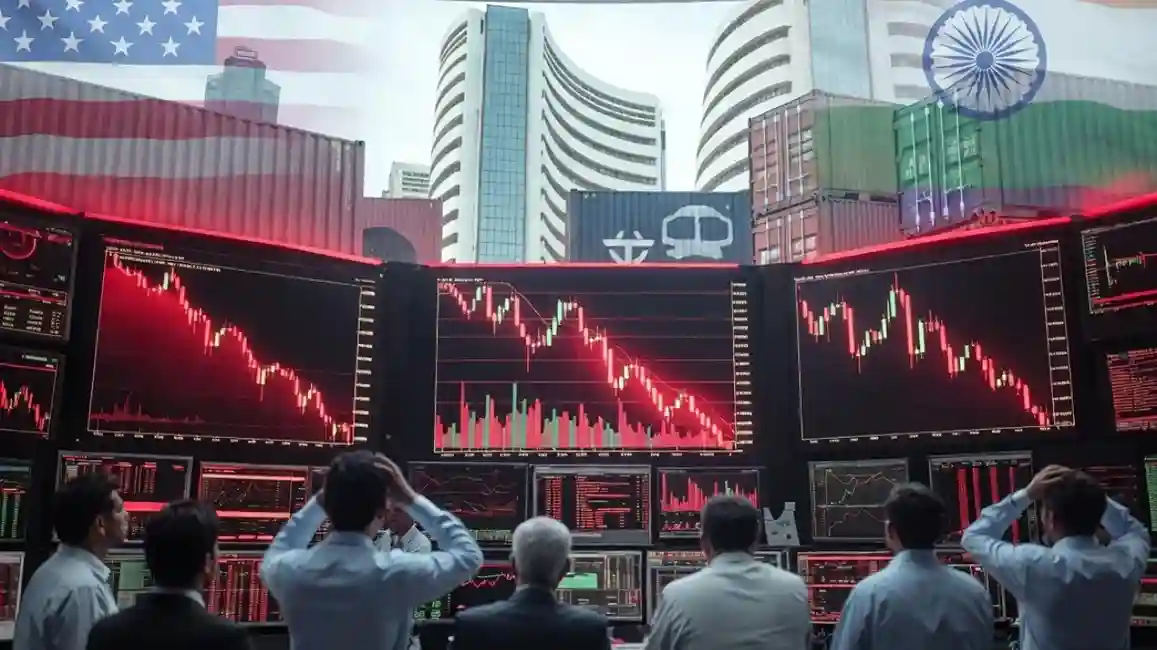
Stock Market Crash July 24 2026 Indian equity benchmarks experienced a sharp selloff in early trading on Friday, July 24, as global markets reacted nervously to US President Donald Trump’s latest tariff order. The US Trade Representative (USTR) announced a 10 percent tariff on 60 trading partners—including India, Canada, the UK, Bangladesh, and Pakistan—under Section 301 of the Trade Act. The announcement triggered immediate riskoff sentiment across international exchanges, wiping out significant market capitalization across largecap and midcap domestic equities.
Stock Market Crash July 24 2026 – Sharp Intra-Day Decline Across Sensex and Nifty
The BSE Sensex opened weak at 75,708 points against its previous close of 76,391, quickly extending losses to fall 917 points to an intra-day low of 75,474. Mirroring the downturn, the broader NSE Nifty 50 broke key technical support levels, sliding 263 points from its prior close of 23,869 to trade near 23,606. Heavyweights across IT, auto, aviation, and financial sectors led the decline, reflecting broad-based selling pressure across the domestic exchanges.
Stock Market Crash July 24 2026 – Major Losers- Large-Cap, Mid-Cap, and Export Heavyweights
Blue-chip stocks witnessed noticeable pullbacks during the morning session. Among large-caps, Infosys fell 3.12%, Eternal lost 2.88%, Bajaj Finance dropped 2.85%, Mahindra & Mahindra slipped 2.82%, and InterGlobe Aviation (IndiGo) declined 2.60%. Losses spread into mid-cap and small-cap counters as well, with Hindustan Petroleum Corporation Limited (HPCL) down 3.30%, IIFL sliding 3.50%, and Muthoot Finance declining 2.30% under sustained institutional profit-taking.
Stock Market Crash July 24 2026 – Global Market Contagion Across Asian and Western Bourses
The domestic market crash coincided with a broader weakness across global equities. Japan’s Nikkei 225 plummeted over 2,000 points, while South Korea’s KOSPI tumbled nearly 6 percent and Hong Kong’s Hang Seng index fell around 2 percent. European stock futures—including Germany’s DAX, France’s CAC, and Britain’s FTSE 100—also opened in the red zone. With Gift Nifty futures down over 200 points, market analysts expect short-term volatility to persist as investors evaluate the long-term impact of new US trade measures on global supply chains and corporate earnings.
👉 Also Read:
Amazon Uber Layoffs 2026 Amazon and Uber Announce Fresh Layoffs in Strategic Realignment
