


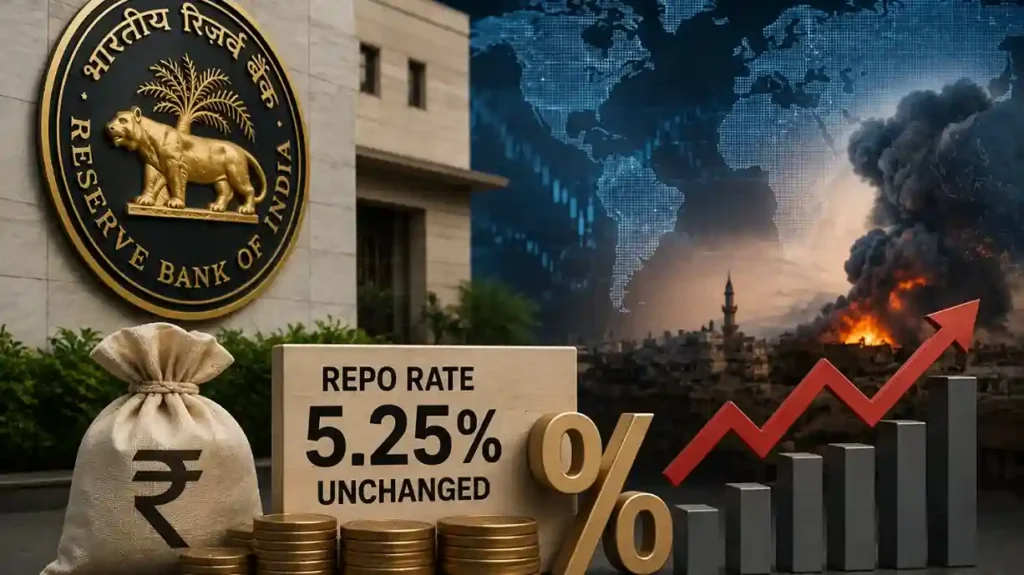
RBI policy – The Reserve Bank of India (RBI) has opted for a steady course, extending its policy pause for the fourth consecutive meeting. Headed by RBI Governor Sanjay Malhotra, the six-member Monetary Policy Committee (MPC) decided to leave the benchmark repo rate untouched at 5.25 percent. This choice brings stability to consumer loan obligations and highlights the central bank’s cautious optimism regarding domestic resilience against a backdrop of complex international challenges.
RBI policy – Weighing Geopolitical Tensions and Global Energy Volatility
Unveiling the policy outcomes, Governor Sanjay Malhotra emphasized that the external macroeconomic climate has turned increasingly complex. The central bank explicitly factored in the re-escalation of the West Asia conflict, volatile global crude oil trajectories, and fresh trade tariff uncertainties. Although domestic economic metrics stay relatively sound, policymakers stressed that ongoing supply chain vulnerabilities require a defensive, data-dependent approach rather than hasty monetary shifts.
RBI policy – Inflation Projections and Resilient Domestic Growth
While headline retail inflation has shown signs of creeping upward—primarily driven by volatile food and fuel components—underlying core price pressures excluding precious metals remain remarkably subdued. For the ongoing fiscal year, the central bank projected real GDP growth at 6.7% with evenly balanced risks, while anchoring CPI inflation expectations around 5%. The RBI noted that domestic high-frequency data continues to reflect steady consumption and structural strength, helping cushion broader external shocks.
RBI policy – Implications for Borrowers and Future Policy Path
Because the repo rate remains anchored at 5.25%, retail borrowers will experience no immediate alterations in their existing home, auto, or personal loan EMIs. Alongside keeping the repo rate firm, the Standing Deposit Facility (SDF) rate stays at 5.0%, with the Marginal Standing Facility (MSF) and Bank Rate fixed at 5.5%. Financial analysts note that the central bank’s neutral stance leaves adequate room to react swiftly if monsoon dynamics or international energy markets shift unexpectedly in subsequent quarters