


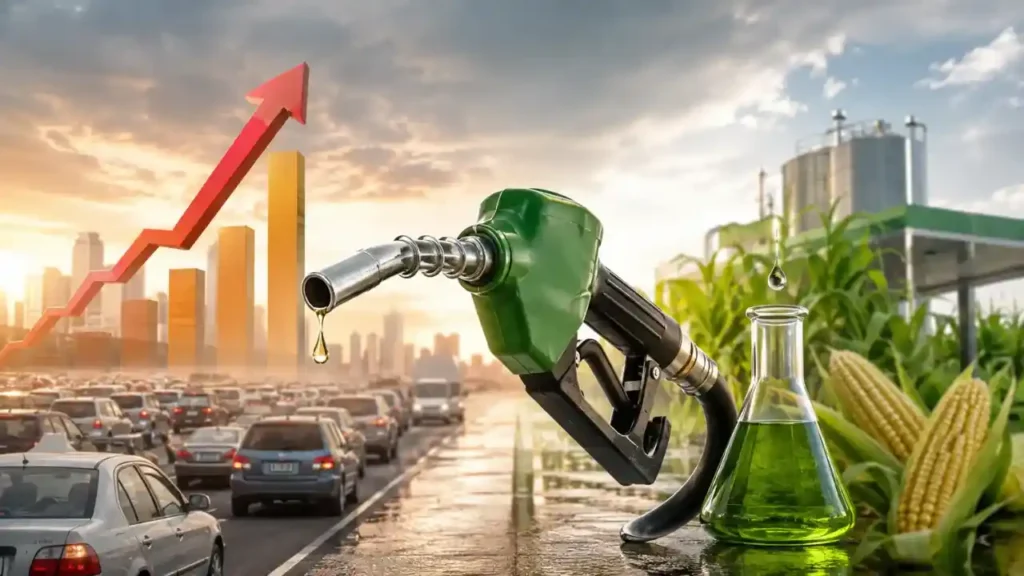
Ethanol Blending The Ministry of Petroleum and Natural Gas has strongly defended India’s Ethanol Blended Petrol (EBP) Programme, revealing that retail petrol prices in Delhi could have surged to around Rs 125 per litre during the recent West Asian geopolitical crisis. Amid rising global crude prices that saw the Indian crude basket touch approximately $135 a barrel, the government asserted that the 20% ethanol blending initiative served as a crucial buffer. By utilizing domestically produced ethanol procured at stable, preagreed prices, consumers were shielded from extreme volatility, ultimately paying Rs 94.77 per litre and saving roughly Rs 30 per litre at the pump during the height of the market disruption.
Ethanol Blending – Cushioning Global Price Shocks and Strengthening Energy Security
Addressing criticisms regarding the costs and viability of the ethanol blending framework, the ministry emphasized that the programme acts as an essential insurance policy for the national economy. With India still importing nearly 88 per cent of its crude oil requirements, incorporating domestic agricultural feedstock significantly cuts down massive foreign exchange outflows. The government noted that the initiative has accumulated over Rs 1.97 lakh crore in foreign exchange savings while injecting more than Rs 1.66 lakh crore directly into the agricultural and distilling sectors, keeping a larger share of the country’s fuel expenditure within the domestic economy.
Ethanol Blending – Clarifications on Food Security and Agricultural Feedstock Utilization
In response to concerns surrounding the diversion of food resources, the petroleum ministry clarified that food security remains the absolute priority of the administration. It asserted that grain procured under the Public Distribution System, the National Food Security Act, welfare programs, and mandatory buffer stocks is never diverted for ethanol production. Instead, the programme relies on surplus grains certified by the Department of Food and Public Distribution, alongside damaged foodgrains and broken rice that are otherwise entirely unfit for human consumption, ensuring a balanced approach between farmer welfare and national food availability.
Ethanol Blending – Addressing Vehicle Performance and Environmental Impact
The government also addressed ongoing debates regarding engine compatibility and vehicle efficiency, noting that extensive laboratory trials and real-world data confirm the safety of E20 fuel for modern engines. While acknowledging a minor 2 to 6 per cent drop in fuel efficiency for older vehicles originally designed for E10 blends, authorities emphasized that the widespread adoption of ethanol has successfully cut carbon dioxide emissions by over 950 lakh metric tonnes. As global energy markets remain unpredictable, the administration reaffirmed its commitment to maintaining the phased ethanol roadmap to ensure long-term sustainability and price stability.
👉 Also Read:
Neeraj Chopra Neeraj Chopra Wins Silver, Yashvir Singh Seals Bronze With LastThrow Heroics at CWG 2026