

Yusuf Rana | Mumbai
Wire Centre
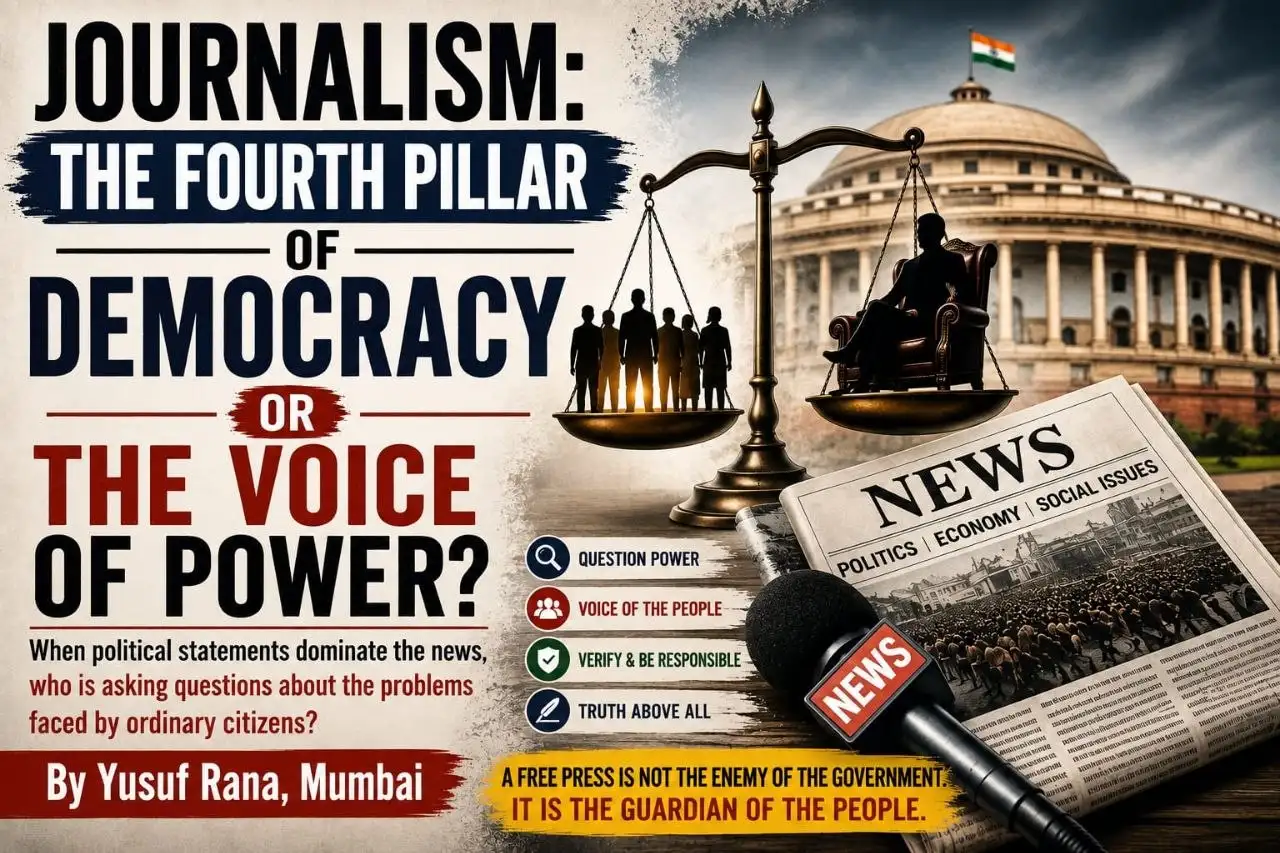
Journalism is often called the fourth pillar of democracy. Its responsibility is not only to report events but also to question those in power, expose failures, verify facts and give citizens a voice. India has a proud tradition of journalism that played an important role in creating public awareness and challenging injustice. But with the rise of television, digital media and social platforms, the nature of journalism has changed considerably. Today, news reaches people within seconds. But the question is: Are we getting more news—or simply more noise? Political statements and controversies frequently dominate news channels, while issues such as unemployment, inflation, healthcare, education, poor roads, water shortages and workers’ problems receive less attention. A politician’s controversial statement can become breaking news within minutes. But a government hospital without medicines or a school without adequate facilities may struggle to get the same attention. The pressure of TRPs, clicks, views, subscribers and advertising has also influenced media priorities. Sensational debates may attract large audiences, but popularity should not be the measure of responsible journalism. The real test of journalism is not how loudly an anchor speaks, but how honestly a journalist questions power. Responsible journalism also requires verification. In the age of social media, an unverified claim or misleading video can reach millions before the truth is established. Being first may bring attention, but accuracy builds trust. Journalists must distinguish between allegations and proven facts. Every side should be given a fair opportunity to respond, and the media should avoid turning accusations into verdicts. Journalism must also maintain the same standards for everyone. If the government makes a mistake, it should be questioned. If the opposition makes a false claim, it should also be questioned. The press should neither become the government’s public-relations department nor the opposition’s propaganda machine. Journalism belongs neither to the government nor to the opposition. It belongs to truth and the public. Most importantly, journalism needs to return to the ground. The real India exists in villages, neighbourhoods, hospitals, schools, factories, farms and markets. A broken road is news when thousands suffer because of it. An unemployed young person is news. A worker waiting for wages is news. A shortage of medicines in a public hospital is news. These are the stories that connect journalism with society. Media should also examine the results of government policies—not merely report their announcements. When a scheme is launched, journalists should ask whether its benefits are actually reaching the people. When a major project is promised, the media should examine its cost, progress and impact. A free press does not mean being hostile to the government. It means being independent of power. Governments and political parties may change, but the responsibility of journalism remains the same: to inform citizens, question authority and protect the public interest. If journalism stops asking questions that matter to ordinary people, the fourth pillar may remain standing in name—but its democratic spirit will be weakened. The true strength of journalism is not the volume of its microphone, but the courage of its questions.
