

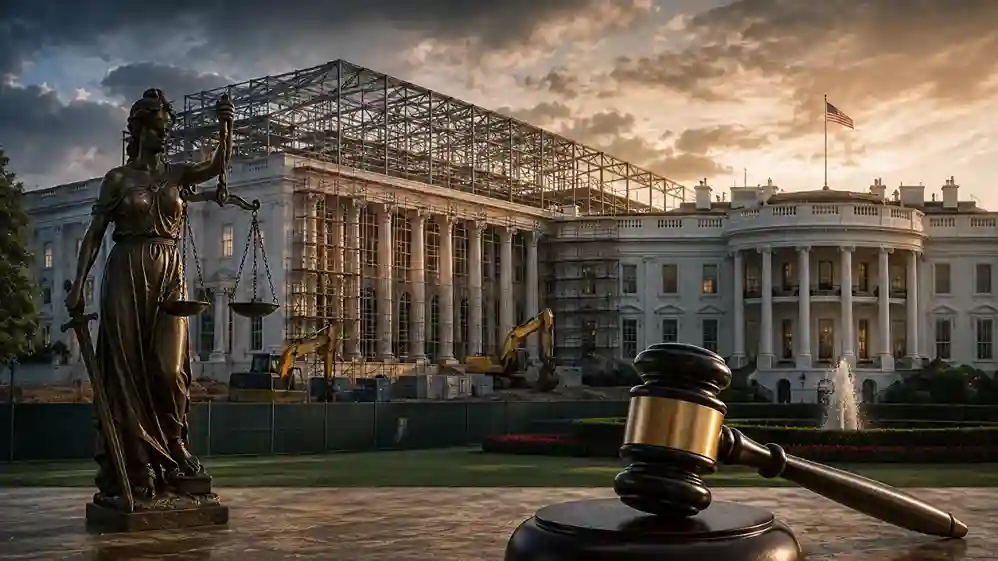
Trump White House Ballroom Court Halt – A US Federal Appeals Court delivered a major legal setback to President Donald Trump by ordering an immediate halt to his administration’s ambitious $400 million (approximately ₹3,500 crore) White House ballroom expansion project. In a sharp 2-1 ruling, the US Court of Appeals for the District of Columbia Circuit admonished the administration, observing that every US President is merely a “temporary tenant” of the White House and not its owner, and therefore cannot make fundamental structural alterations without explicit Congressional approval.
Trump White House Ballroom Court Halt – Injunction Upheld Against East Wing Demolition
The federal court panel upheld a preliminary injunction obtained by the National Trust for Historic Preservation, which had filed a lawsuit challenging the administration’s decision to demolish portions of the White House East Wing. The preservation group argued that beginning construction on a 90,000-square-foot ballroom without statutory authority violated federal heritage protection laws. The court emphasized that deciding whether to build a massive new structure rests with Congress rather than unilateral executive discretion.
Trump White House Ballroom Court Halt – Constitutional Boundaries and Public Ownership of the White House
The ruling highlighted that the White House remains public property maintained for current and future presidents as well as the American people. Judges noted that the executive branch holds no private ownership rights over the landmark, questioning the administration’s authority to execute large-scale redesigns independently. The court granted a 14-day stay on its order to allow the administration time to file an appeal before higher judicial authorities.
Trump White House Ballroom Court Halt – Trump Administration Vows Supreme Court Challenge
Responding to the judicial setback on Truth Social, President Donald Trump expressed strong disagreement with the ruling and announced that his administration will appeal the decision to the US Supreme Court. The confrontation marks an escalating legal clash over executive power, historical preservation standards, and the constitutional limits of presidential authority over federal property.
